Showing posts with label Practical Concerns. Show all posts

Sunday, February 10, 2008

GreenCard Update

Mark and I now have our greencards, but Emily and Lauren's birth certificates are not acceptable to the USCIS because they don't have their parents' names on them. We've got until the end of this month to produce adequate certificates, so I've had to order some especially from the UK's General Register Office at £26 (about $50) each (including p&p). Here's Mark's account.

Thursday, December 27, 2007

Catch-Up

Mark at our hotel at Myrtle BeachI haven't blogged since April. Mark kept the ship afloat for a while, until he decided to start his own personal blog.

So, the question was, what should I do? Should I try and keep the blog going even though I no longer seem to be able to find the time and energy, or should I just quit while I'm ahead?

Realistically speaking, I don't think that I'm going to be able to write as regularly as I have done in the past. But, I'm not quite ready to throw in the towel. I think that I might try and keep it going, but perhaps on a more irregular footing.

Viola in the car en route to Myrtle BeachIf you would like to know whenever I write something, but can't be bothered returning here regularly to see if I've posted anything new, you can be notified of updates by subscribing to the feed.

"So, what have you been doing during your unsolicited absence?" you may well ask. Here's some highlights:

Disney World

About 9 years ago, back in November 1998 Mark had a conference in Disney World, Orlando. We decided to go as a family. Lauren was just over a year old and Emily had recently turned 4. Mark would go off to his conference and we would see him in the evenings. We decided then that we would like to take the girls again when they are old enough to remember it a bit more and when Mark can enjoy the holiday instead of having to work.

The drive to Disney World
(Source)
Now, here we are living in America, only about 630 miles from Disney World. We would not have to pay about $3000 in air fare, just to get there. In addition, this year Mark had a milestone birthday. So, this Spring Break we all jumped in the car and drove down to Orlando, Florida. We had a great time at SeaWorld, MGM Studio, Epcot, Animal Kingdom and Magic Kingdom.

As an aside, I have to thank Mark's student's Dad who works at MGM Studio for getting us three days of Disney park hopper tickets.

Work Permit and SSN

My EAD came through at long last at the beginning of May, so I am now able to work (even though the SSA had to send my Social Security Number (SSN) application to Homeland Security, who didn't return it for about three months). I am self employed and working from home, but am contracted to TPF Software. At the moment I'm working on web-based stuff (mainly PHP) and some Delphi stuff as well.

Trips

We've taken a few trips over the past few months. These have mostly been covered by Mark, so you can read a bit more about them there if you like.

We went to:
Emily and Lauren at the hotel at Myrtle Beach

Tuesday, April 10, 2007

Mark's and My Birthdays

My Birthday

This year, my birthday was a fairly low key affair. Mark and I went out for lunch (Red Lobster). In the evening we all went out for ice cream (Marble Slab Creamery). I had cheesecake ice cream with cookie dough in a waffle cone (they make the waffle cones fresh on site). To circumvent a large proportion of the guilt that is normally associated with such indulgences so that we could all the more enjoy the treat, we gave the children a proper dinner, but Mark and I made the ice cream the dinner and ate nothing else that evening (although we did round the evening off nicely with some whiskey/sambuca).

Mark's Birthday

Birthday BalloonsMark's birthday was the big 40 and was a bit more eventful because the good ol' USCIS picked that day for our biometrics appointment in Charlotte.

For those who are not in the know -- once the USCIS have acknowledged receipt of one's greencard application, one has to travel to one's nearest USCIS office (which in our case is in Charlotte, which is about a three hour drive) to have fingerprints and photographs taken. Mark opens his presents on a grassy bankOur appointment time was 9am, so rather than having to leave home at 6am to get there in time, we drove down the night before. We arrived for our appointment on time, but had to wait a couple of hours to be seen. The actual fingerprinting and photographing took a total of about 10 minutes.

Click here to watch the videoAfter that, we sat on a grass bank so that Mark could open his presents. Then we went to the South Park Mall for some good old fashioned shop therapy before the three hour drive home. The video shows us having a little bit of fun in one of the department stores.

Sunday, April 08, 2007

H1B Quota Filled in Just Three Days!

The USCIS started accepting applications for H1B visas for the 2008 fiscal year on the 1st of April 2007. On the 3rd of April the USCIS announced that they had enough applications to reach the congressionally mandated cap of 65,000. They had received over 133,000 applications in the first three days. This means that on the first three days of accepting applications they had received more than double the number of applications than there are visas.

When I think about the likelihood of my being able to get an H1B, the term "snowflake's chance in hell" springs to mind.

Monday, March 19, 2007

Cricket World Cup

Brian Lara
Brian Lara
Last year, both Viola and I blogged a good deal about the football (American: "soccer") World Cup 2006. That massive tournament, one of the biggest international sporting events, makes only a small dent on American consciousness. It is shown on mainstream channels like ESPN, and there are a million or so viewers, but it is very minor by way of comparison with American sporting events like the Super Bowl (an American Football event), which has a massive, multi-million audience. But while few Americans watch the football World Cup, at least one can say that many know about it. That is not the case with the Cricket World Cup which is currently under way in the West Indies. The U.S.A. is a completely cricket-free zone. I have yet to meet anyone in the US who is even aware that there is a cricket World Cup, let alone that it is happening now, that it is drawing big headlines in many other countries, and that it is happening nearby, in the Caribbean.

For those who are unfamiliar with the cricket World Cup, it has happened every four years since the first one in 1975. This year it is the first time that it is in the Caribbean. It always involves all the major cricket playing nations (currently England, Australia, New Zealand, India, Pakistan, Sri Lanka, South Africa and West Indies) and adds an additional eight nations, a couple of whom are almost major cricketing nations (Zimbabwe, Bangladesh), and the rest of whom are disparagingly called "minnows" (this year Canada, Kenya, Bermuda, Scotland, Ireland, the Netherlands). It lasts for a month and like the football World Cup, there are group stages to begin with, four groups with four in each (two major, two minor in each). The top two in each of these groups goes forward to the "Super Eights", and the top four from the Super Eights go forward to semi-finals and final. The assumption is that the eight major nations will make up the "Super Eights", but one of the exciting things that can happen is that one or more of the minor nations can make it through the group stages, displacing one or more of the major ones.

The other thing you need to know about the cricket World Cup is that it is "one day" or "limited overs" cricket. This is the popular, fast paced version of the game that dates back to the early 1970s. Each side gets 50 overs to make the highest total they can; the highest total wins the game. So a one day match is a hasty six or seven hour affair, unlike the first class game which lasts several days. It would be impossible logistically to have a first class cricket world cup because it would take too long for each nation to play all their matches. Since the 1980s, the one day form of the game has also departed from the first class game by using coloured costumes, a white ball and black sight screens, rather than cricket whites, the traditional red ball and a white sight screen. The colourful appearance and the fast pace adds to the popular appeal of the one-day game, and the excitement of seeing sixteen nations all in the same place makes the World Cup the most thrilling arena for watching one-day cricket.

Given the absence of interest in cricket in America, it is not surprising (though it's disappointing) that it is not on mainstream television at all and it is not reported in any Sports bulletins. I suppose the one place where the American might hear about the World Cup is on BBC World Service, which is broadcast all night, where we live at least, on WUNC, North Carolina's portal for NPR (National Public Radio), which is a kind of American version of Radio 4. When I went to bed at 1.30 last night, the World Cup was the sports headline on World Service, which was being broadcast on WUNC/NPR.

So, to ask the question we have asked here before, How do you cope without British TV and Radio?. If you have Dish Network, you can pay $199.95 to get full World Cup coverage. But we can't get Dish at our house (details of the palaver here) so the only options are via the internet. Willow TV provides internet streaming of a reasonable (not brilliant) quality for a hefty $199.95 a month; the other option is to spend time searching for P2P options from around the world.

What I tend to miss, though, is the Test Match Special commentary from the BBC. TMS is a British Institution and while I was thrilled to find that I could get hold of it over the internet in the summer, they block access to international users for any cricket outside of the UK, including the World Cup. But all is not lost. The TMS Podcast is back again for this World Cup, two-three times a week, and it's a treat. Second on the podcasting front is The Guardian's Cricket World Cup Show, an excellent podcast out every two or three days. The other British papers are lagging way behind on this one. Nothing at The Independent, nothing at The Telegraph, one paltry Cricket World Cup Podcast so far from The Times.


"Freddie" Flintoff
All in all, the internet provides one with lots of ways of keeping in touch with what is going on, and podcasting is a particular pleasure this time round. What of the action so far? England's chances of winning the World Cup are vanishingly small. We began about as dismally as everyone expected, losing the first of our group stage matches, against New Zealand. We won our second, on Sunday, against Canada, one of the so-called "minnows", but we didn't win convincingly. The match was overshadowed by Andrew Flintoff's antics off the field. The English love "Freddie" Flintoff, and will forgive him, especially after his contrite performance at a press conference today, but he was reported to have got drunk on Friday night / Saturday morning, not long before the Canada match, and was seen out on a pedalo at 4am, and he allegedly had to be rescued. He was stripped of the Vice-Captaincy, dropped from the side for Sunday's match, and five other England players were fined. Now England have a few days to get it together before the match against Kenya on Saturday, which we have to win to go through.

Even that, though, was overshadowed by the sad death of Bob Woolmer on Sunday morning. Woolmer was a former England cricketer who was the current coach of Pakistan, and he was found unconscious in his hotel room on Sunday morning; he did not regain consciousness. The news came through as we were watching the England v. Canada match over our Sunday lunch of roast beef and Yorkshire pudding. Woolmer's death has cast a shadow over the whole World Cup, and the cause of his death is not yet clear. It came the morning after one of the most remarkable cricketing results ever, on Saturday, when Ireland, another of the "minnows", beat Pakistan, one of the giants, and knocked them out of the World Cup. The fact that this remarkable result happened on St Patrick's Day made it an additional cause for celebration.

Other cricketing highlights include a remarkable performance by South Africa (major team) against the Netherlands ("minnows"), including six sixes in an over by Herschelle Gibbs, a fantastic achievement, already uploaded to YouTube. This was the first time this had ever happened in a World Cup.


And today, in between classes, I was pleased to be able to catch the last few overs of India's massive total of 413 against Bermuda, the first time any side has got over 400 in a World Cup game, and this after India were surprised by a defeat at the hands of Bangladesh on Saturday. Oh, and one other highlight, in what has been a fantastic first week, was the tied match between Ireland and Zimbabwe (a tie is very rare in cricket).

Who will win the World Cup? Certainly not England. I suppose you have to put your money on Australia. I fancy South Africa to reach the final. Dark horse bet: New Zealand.

Thursday, February 08, 2007

Green Card Application Filed

The Greencard ApplicationLast week I took my Green Card application in to Duke International Office and walked back to my office with a spring in my step. This happy moment came after months of work on this application and a huge amount of time invested. The picture you see here is the application just before I took it in to the International Office. The amount of paperwork exceeded the size of my DPhil thesis. The days and weeks spent on this application were days and weeks sucked out of my research time, my family time, my sleep. I found the entire process unreasonably exhausting and sometimes depressing. So why did we go ahead with it?

At present, I am on an H1B visa. An H1B is employer-specific, i.e. your prospective employer sponsors you for this visa status so that you can work for them. An H1B holder can bring a family with him/her, all of whom will be H4 "dependants", a trailing spouse and children. Many who come to the USA to work remain in their H1B and H4 visa status until they return home. As an H1B or an H4, you are a "non-resident alien", which means that you are here for a temporary period only, and are not regarded as "resident", for immigration purposes at least. These visas give you three years from date of entry, and are renewable for a further three years, so you have six years in total. But you have the option of applying for "lawful permanent residence" (LPR, or more popularly "Green Card") at any point during that temporary stay, and this is what we have just filed. When granted, somewhere between six months and two years after filing, you become a "resident alien".

There are several advantages to filing for your Green Card. One of the most immediate is that it is possible for the H4 dependent, in this case Viola, to file at the same time for a temporary work permit. We have heard that the work permit is usually issued within two months of the Green Card application being filed, which means that Viola may be able to begin work in April. Apparently one has to take great care to make sure that the Green Card application is not what they call "frivolous" -- they only grant the work permit if they feel that you are taking the Green card application itself very seriously. A second advantage is that the Green card gives you much greater flexibility in the future. We are not bound to the USA for just that temporary period. A third advantage is that it will enable me to accept employment from others in the USA. At present, I can only receive payment from Duke, so when I give lectures elsewhere in the US, or read manuscripts, or write pieces for American publishers, or sit on PhD committees at other universities, I cannot accept payment. What I do at the moment in these circumstances is to ask the employer in question to donate my honorarium or fee to a charity of my choice, and so far they have always been happy to do that.

Those advantages made it pretty clear that we must go ahead and file for lawful permanent residency. The process, however, was so daunting that procrastination was often pretty tempting. I won't bore you with the details except to explain that there were two parts to the application, one our family's application and one the employer-sponsored part of the application. The latter was the most work. I am filing in category EB-1(B), which means that you have to demonstrate that you are what they call an "outstanding professor/researcher", and this involves the collection of piles and piles of paperwork of every kind imaginable. A couple of things made it bearable, though. Viola helped with a lot of the paperwork and so shared some of the frustration and anxiety. And Duke has an International Office that provided some fantastic support. One of the happiest of my several visits there was the first one where they took away at least half of the blank forms I was carrying and threw them into the recycling as forms I didn't need to worry about.

Oh, by the way, it also costs a fortune to do this. Including medical examinations, we have spent over $3,000 so far on filing. Here's hoping that it was all worth it.

Tuesday, November 28, 2006

How to cope without British TV and Radio: Cricket Supplement Update II

Mark writes:

See previous posts in this series, How to cope without British TV and Radio: Cricket Supplement and How to cope without British TV and Radio: Cricket Supplement Update.

The Ashes Urn
The Ashes
As all British readers will know, the Ashes is here again. "The Ashes" is the name given for any test series involving England and Australia, where "test series" means a series of Test Matches. A "test match" is a five day international cricket match. There was great excitement last time around, when England beat Australia in England in the summer 2005, the first time we had done so since 1987. And the series was thought by many to be one of the best test series ever. Now England are in Australia and Australia are all set to win the Ashes back. With one test down, Australia are already one-nil up. The second test begins on Friday and England are going to have to raise their game if they're to stand a chance.

Watching overseas tests in America presents some serious challenges, greater even than the home tests during the summer, although this time we have not had our lawn dug up or holes put in our roof. To watch this series on TV, you have to have the satellite service DirecTV. There is no other way of doing it. You can't pick it up on Dish Network, nor can you get it on your cable package, even for subscription. So if you don't have DirecTV, your only option is to go for the Broadband coverage on your PC via Willow TV. This costs $99.95 for the whole series. I've been reticent to make the purchase this time, especially as the fourth test and most of the fifth test will be on when we are in the UK for Christmas. Also, the direct streaming is pretty good but it is not brilliant, and for cricket you really do need a good picture. I may still succumb at a later point, especially if England start playing a bit better, but for the time being I am managing without.

So without any TV coverage, how does one cope? One of the most disappointing things is that there is no BBC Test Match Special coverage available to international users. It is only available to UK users. This is a real nuisance. To be honest, I miss TMS so much that I have looked around to find alternative, unofficial means of picking up the Radio 4 LW stream, or the FiveLive SportsExtra stream. Happily, there are ways of doing this if one is prepared to spend a bit of time messing about on the net. Unhappily, the Radio 4 LW stream is not always accessible. When that happens, I can usually get the ABC Australian commentary, which is not at all bad, and features Jonathan Agnew, who is good enough to say the score Aussie style (1 for, 2 for etc.).

One great new innovation this season, though, is the Test Match Special Podcast. This is 17 minutes or so of Jonathan Agnew and Geoffrey Boycott chatting about the day's play. If you are into downloading podcasts, this is a great new thing, and I hope it will appear again next season for the home tests.

Friday, November 24, 2006

Electrics and Electronics

The Sitting Room Setup
The Sitting Room
When one moves overseas, one faces the potentially expensive problem of what to do with one's electrical and electronic possessions. The problem is threefold:

  1. The mains voltage supply in the UK is 230V and in the US it is 120V
  2. The UK current alternates at a frequency of 50Hz, whereas the US frequency is 60Hz
  3. The UK's video colour system is PAL, whereas the US uses NTSC
We were advised by some to sell/give away all our electrical/electronic items and buy new ones in the US. We partly decided to do this, but were reluctant to lose all our electrical possessions. There were some that were fairly new, some that were presents that we did not want to part with and some that we particularly liked. In addition, getting rid of everything and buying everything new was a potentially expensive option.

If you're thinking of moving to the US from the UK, or vice versa, you are bound to be faced with a similar dilemma, so, just in case it helps, here's how we approached the problem:
  1. We took an inventory of all our electrical/electronic devices along with their voltage/wattage.

    For the most part we ignored the frequencies because frequency converters are very expensive and we didn't think that the difference in frequency would adversely affect most of our devices because we were going from 50Hz to 60Hz. If you're moving from the US to the UK, however, you might need to consider this as this may affect some of your decisions.

    Some devices, such as many computers (but not all), are built to accept dual voltages, so only needed plug adapters to work in the US. When using adapters, it is worth bearing in mind that some appliances need to be earthed and one would need an earthed adapter for these.

  2. We decided which devices we really wanted to take. These included the TEAC HiFi system and Emily and Lauren's micro systems that were birthday presents and were quite new.

  3. We decided which devices to give away (such as the washing machine, tumble drier, big TV and vacuum cleaner). We kept one TV and a multi-regional VCR because we have a lot of PAL videos that we wanted to be able to watch in the US, including the "Born in the UK" series of videos that the Everyday Eavesdropper regularly sends us. We also have a PAL PSOne that the children wanted to keep.

  4. Of the items that we decided to keep, we thought generally about which devices are likely to occupy which rooms (e.g. the food processor would obviously go in the kitchen).
The Kitchen's Transformer
The Kitchen
(the transformer is hidden
in a cupboard)
We also kept any extension strips (with rows of UK plug points) to take with us. This was because the plan was to buy a step transformer for each room in which we put UK devices, then plug all the devices for that room into a single transformer via the extension strips. We also had to buy a video converter for the VCR because it turned out that although the VCR was multi-regional in that it could play both UK and US videos, it could only output to a PAL TV. We also found that our TEAC DVD player was not multi-regional and could not be made so using a handset hack, so we would have to spend a fair amount of money to send it off and get it professionally altered. Our solution was to keep the TEAC DVD player boxed and buy a cheap one from Walmart. We then used a handset hack (one types a specific sequence into the remote control to set the region-encoding of the DVD player) to make it play both Region 1 and Region 2 DVDs. (NOTE: To get a handset hack, just google your DVD player's model reference and the words "handset hack".)

We also made sure that the TV we bought had a plug-point for a PC so that we could download or stream UK TV programmes through a laptop computer to the TV. This is much more enjoyable than having to gather around a small computer screen.

We used the wattages that we'd gathered in our inventory to work out the wattage needed for each of the transformers.

As a result, we now have transformers of varying wattages in the kitchen, dining room, sitting room, study and our three bedrooms as well as a number of plug adapters for those appliances that can work on the US voltage. We went for straight-forward transformers rather than the more expensive voltage regulators just to keep costs down, but you might choose to stabilize your voltage with a regulator.

The pictures show a couple of examples.

Here's a few useful links:
Electricity Around the World
PAL SECAM NTSC Conversion
Voltage Guide
World Import FAQs
Frequency: 50Hz vs. 60Hz
DVD Compatibility FAQ

Tuesday, October 24, 2006

An Update on the Job Situation

Ren asked how my job search was going. I realised that back in November last year I mentioned the plan to get a job:

Before leaving the UK, the plan was to come over to the US on a non-working visa. I would then apply for jobs where the employer could sponsor my upgrade to a working visa.
Trailing Spouse, November 2005

The USCIS only award 65,000 H1B visas a year. A year begins in October and they start accepting applications for a given year at the beginning of the preceding April. As we only moved to the US at the end of September last year, I'd pretty much missed the boat.

I decided to aim for October 2006. With this in mind, I sent out my CV and covering letter to various companies, explaining my situation. I managed to get a company to sponsor me to upgrade my H4 (non-working) visa to an H1B (allows me to work). Unfortunately, the company were badly advised by the attorney that they had hired to guide us through the process. They were advised that we should start the procedure in about June/July 2006 so that I can start working for them in October 2006, so we twiddled our thumbs for a bit, then tried to re-contact the attorney at the start of June, just to find that he would not return our calls. As soon as we realised that something was amiss, we wasted no time in finding another attorney who informed us that applications start being accepted in April, but that all 65,000 H1B visas were fully allocated by the 26th of May.

Now, we are aiming for October 2007 (starting the application process in March, so that the application can be submitted at the beginning of April).

I've added another string to my bow in that we've decided to try applying for greencards. It turns out that I may be able to submit an application for a temporary work permit while my greencard application is being processed. We would have to apply for a greencard eventually anyway, so we may as well do it sooner rather than later.

Tuesday, July 04, 2006

How to cope without British TV and Radio: Wimbledon Supplement

Here's another post by Mark:

In a series of posts, I have discussed strategies for UK aliens who are missing British TV and radio, How to cope without British TV and Radio; Part 2; Part 3; football supplement; cricket supplement; cricket supplement update (see also the related post World Cup Coverage in the USA). The excitement of the World Cup, and England's recent exit (the ultimate antidote, England fans, if you haven't already listened to it, is found in Baddiel and Skinner, Podcast 11: The Britishers are Coming Home), have delayed the necessary supplement on Wimbledon coverage (but see, of course, Viola's post on Wimbledon).

If the TV coverage is anything to go by, Americans appear to like tennis more than football, but only a little more. I am quite surprised about this since I had expected the USA's success in tennis, and its many famous stars, to generate some real enthusiasm for the sport. Now it may be that my perception here is a little warped because we are talking Wimbledon. Perhaps the US Open will get much more coverage and publicity when that comes around. In the UK, we get obsessed with tennis for a fortnight every year, the Wimbledon fortnight, and the rest of the year we don't care. Maybe it's the same here when it comes to the US Open. Anyway, in the mean time, one can watch Wimbledon on telly without too much trouble. Here in North Carolina, one of the networked channels, NBC, shows Wimbledon live every morning until 1 pm (6 pm in England), and then coverage continues on ESPN2, which is one of the sports channels available on cable. The commentary, analysis and interviews are pretty good and there is a full American presence at Wimbledon, not the skeleton presence ABC Sports and ESPN have in Germany for the World Cup. The only annoyance is that the NBC coverage, which is supposed to be available in widescreen High Definition, is not, at least here.

Inevitably, we want to supplement the American coverage with some British perspectives from the good old Beeb, and with Wimbledon it turns out that this is particularly straightforward. All of the FiveLive Wimbledon coverage is available to international users on-line, though if you try to listen to the commentary while watching NBC or ESPN, the radio commentary is about 5 seconds behind the pictures (the opposite of the cricket problem, where the Willow TV pictures are behind the TMS coverage). This came in handy when the American TV coverage were not showing Andy Murray. FiveLive also has a Live Webcast, which is fun but I have not yet found a way to get the picture in broadband quality. On the other hand, the BBC Sports Player (follow that link to get the Broadband version) has an excellent news, clips and highlights service -- strongly recommended.

[Post repaired 30 June 2008]

Monday, June 19, 2006

World Cup Coverage in the USA

Everyone has now played at least two matches, so I thought that it was about time that we reviewed the American coverage of the World Cup. Here's Mark's take:

In the months leading up to the World Cup, my anxiety was over whether it would be possible to get coverage at all on the TV here. It was a great relief to discover that every single match would be broadcast. In fact the energy and enthusiasm that goes into the American broadcasts makes one think that there must be reasonable numbers of Americans watching this. If so, they don't live near us. We did meet an American gentleman in a second hand bookshop on Friday who recognised our English accents and declared himself an Arsenal fan, and he was surprisingly knowledgeable about football and had some interesting and useful advice for Sven-Göran Eriksson on where to play Steven Gerrard and Frank Lampard. But he was the exception.

Around here there is not even a World Cup blip, never mind World Cup Fever. I rather miss the England flags on the cars that one sees in England during the World Cup, and I've ordered my own from ebay (for 2p [+ £5.98 p&p (Ed.)]) so that we can do our own little bit. They do have car flags here, and the occasional car around here has a Hurricanes flag on it at the moment. This is, I think, something to do with a local ice hockey team, but with the World Cup on, I've not had time to look into it.

What, then, of the American TV coverage? One of the great pluses is that every game is available in High Definition if you are lucky enough to have the equipment (as we are -- it comes free to Time Warner Cable customers in our area -- you just have to ask for it!). And my goodness, you can tell the difference. It has to be said that the general digital cable coverage is rather inferior to the digital cable coverage we were used to in the UK, e.g. broadcasting in widescreen is the exception rather than the norm. But where High Definition is available, it trumps the standard definition digital coverage by some way. The matches are shown across three channels, but all part of the same company, ESPN, ESPN2 and ABC Sports, but they broadcast across two channels each, one for standard definition and one for high definition.

One downside with the picture is that they have a huge strip at the top, taking up a large part of the picture, essentially just to give the score, the sponsor, the time, a great deal less efficient space-wise than the nice BBC and ITV equivalents. And for some of the match on High Definition, and all of it on Standard Definition, they have a monster ugly strip at the bottom which speaks in code to those in the know about American sporting events. And like ITV coverage in the UK, there is an unbelievable amount of advertising, for about nine-tenths of half-time. So you don't get a lot in the way of the pundits in the studio, which is a shame because one wants to hear some analysis and see some replays. But then again they haven't got Alan Hansen, or Mark Lawrenson, or Gary Linekar, so one can take or leave the half-time commentary anyway.

Speaking of the BBC commentary, I do miss Motty too. For non UK readers, John Motson is simply the king of football commentary, and that's the end of it. MiniMotty is all very well, but no substitute for the real thing. Having said all that, the American commentary is most enjoyable. The team they seem to use the most is Dave O'Brien and Marcello Bilboa. I think the latter is a former America "soccer" player himself, while O'Brien has a voice like Principal Skinner on The Simpsons. For some of the other matches, they have a British guy whose name I've forgotten, who sits alongside a guy with the most pronounced Irish accent I've ever heard (Tommy something). The commentators all work hard to explain the game to newcomers, something I find highly commendable. They endlessly explain how red and yellow cards work, how many substitutes are allowed and so on. They are also highly opinionated, especially over the red cards in USA's match with Italy.

Some of the terminology strikes an Englishman as a little odd. They talk about a match being a "tie" rather than a "draw"; they never use "nil" for 0; nor do they use "all" for draws, so it is "one to one" rather than "one all"; and "one-nil" is "one to nothing". But on the whole, it is easy enough to translate. My only criticism of some of the American commentary is that it is occasionally more akin to radio commentary than TV commentary and will lapse into describing what we can see in front of us. At times too, when commenting on England games, you can't help thinking that the commentators are seduced by players' reputations and make more of them than their performances deserve. In particular, England are often referred to as "David Beckham's men" and we must have heard "bend it like Beckham" a dozen times in England's first match.

We have supplemented the American coverage with plenty of other British materials to get a flavour of what is going on the UK. The Baddiel and Skinner podcast is pure joy. Straight after each England match we listen to the FiveLive football phone-in 606. I like to catch the World Cup Daily and of course I keep an eye on the BBC Sports Player (available in broadband from that link). I do crave a bit more British coverage, but for now have resisted the temptation to connect to a proxy server and pick up the BBC live coverage. And it is fun to enjoy the odd little slip by the American commentators, "Michael Beckham" in the first England game and the England side called "Germany" at another.

June 22, 2006

I finally succumbed to temptation yesterday and downloaded a Match of the Day highlights programme because I was missing the BBC coverage, and it was a real joy. The one I watched was the day of the England v. Sweden match. Adrian Chiles was presenting, a Brummie I know well from 606, and he did a great job. And it was good to see Hansen doing the business, and to hear Motty and Lawro on the commentary. But watching the broadcast reminded me of things that are standard in the British coverage but which are remarkably absent in the American ESPN / ABC Sports coverage. As I commented above, there is no time for punditry -- hardly even time to replay goals, let alone analyse the game and comment on controversial moments. It's a shame because the team they have in the studio seems fine.

Most striking, though, was seeing interviews again. The American coverage simply lacks any interviews with key players and managers after the match and I had hardly noticed it until now. The exception was after the USA Ghana match today when the American coach (Arena) was interviewed. But normally speaking it creates some real detachment from the tournament. In fact it's clear that the USA have a real skeleton crew in Germany. You occasionally get to see Dave O'Brien and Marcello Balboa live at the ground, but that's it. The pundits appear to be in a studio in the US and not in Germany. There is nothing of the atmosphere from the streets of Germany that characterises all the British coverage. I suppose I've not missed that particularly because I've been watching Match of the Day's World Cup Daily and have immersed myself in FiveLive's coverage.

A couple of other pleasures on the podcasting front are worth mentioning. First, when I wrote the above, I had not realized that the Daily Mayo Podcast had gone over to a World Cup special. The Daily Mayo is part of my regular podcasting diet, but I'd tuned out at the beginning of the World Cup and it turns out that that was a mistake. Each day, Simon Mayo introduces highlights from FiveLive's broadcasts on the World Cup each day. Essential listening, and great fun (e.g. the man who had taken a sickie so that he could go and watch England and then got filmed, drunk, by SkySports, and seen by his boss!). And I hadn't realized that 606, also available as a podcast, is broadcasting most days, and is worth listening to most days -- and not just on England match days. A particular feature of note was Monday's programme, which focused the Prime Minister, Tony Blair, as one of the co-presenters of the phone-in. He was well worth listening to, too. And the Daily Mayo presented some highlights from the programme the next day.

Apparently the Baddiel and Skinner podcast previously mentioned is doing brilliantly -- and that's not surprising -- it's great fun. I loved Fantasy Football with Baddiel and Skinner in 1996, 1998 and 2004 so it's great to have them back on form again (and also interviewed on Tuesday's Daily Mayo). As well as all this, I've been dipping into the Guardian's daily World Cup podcast, which appears late evening (American time) every day, and it's worth a listen.

And one last thing: don't miss Gervais and Merchant tackle 'the Crouch'.

Here's my wallchart.

Tuesday, June 13, 2006

How to Send International Texts (SMS)

Today, Mark is going to outline some of the things he has learned about sending transatlantic SMS messages:

A couple of months ago, Viola gave me a guest spot to explain how we are using New Technology and Old-Fashioned Communication to write letters and telephone people back at home in the UK. One thing I didn't tackle there is the question of sending text messages internationally, something I've recently spent some time exploring because I had struggled to send international texts from my mobile phone. So this post explores ways in which you can send texts internationally. The remarkable thing is that you don't even need a mobile phone to do it. Note: in the UK, your mobile phone is always called your "mobile". Here in the US, the term "mobile" is understood, but everyone uses the term "cell phone" or "cell".

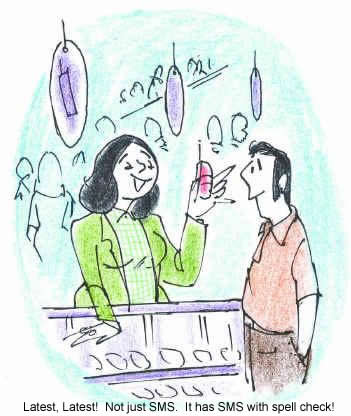
Woman selling mobile phones.  Caption: Latest, latest! Not just SMS.  It has SMS with spell check!
For some reason, outgoing SMS text messaging on my American mobile phone (Verizon Wireless) only works with some UK networks. So I find that there are some friends and family in the UK that I can text and some I can't. This is, of course, not very convenient and it is not cheap either, at something like 20¢ per text message sent. On the other hand, I seem to be able to receive texts from almost any UK mobile. So my mind turned to discovering whether it was possible to do some (outgoing) international texting cheaply via the internet. The issue was focused particularly by a family birthday (when texting often has to substitute for a card, sorry!) and by the World Cup, when texting friends and family adds to the excitement during the England matches.

If you are wanting simply to send free texts from your PC to someone's mobile within North America, it's easy. The service I've tried and tested, and which work fine, is SMS Everywhere -- a simple web interface for sending free texts. Or for email to mobile phone, try Teleflip, where you simply email (yourcellphonenumber)@teleflip.com. But this doesn't solve the international problem. For this, there is something that looks like an ideal solution if you can get it to work for you. CBFSMS allows you to type your text message into an SMS Gateway on the web and so send free texts to British mobile phones. Alas, it doesn't work for me -- our ISP is blocked because of abuse. As far as I am aware, that's it for free options, but there are several other relatively cheap ways of sending texts to the UK via the internet.

The one that is working well for me is a new service from Skype, Skype SMS. You can access it from within Skype, and so it works off your Skype Out credit (the money you have deposited for phoning your friends and family back home). To get access to this, you need to download Skype 2.5 BETA. I've tested it several times and it's working well for me, and costs under 10¢ per text sent, considerably cheaper than my mobile rate. At present, the service is outgoing only, but it allows you to set up your profile so that you can receive texts back on your mobile, which works well for me since I have no problem receiving international texts. So now I am sorted, at least as long as I am near my laptop and with an internet connection, which is most of the time.

Other ways of texting people back in the UK include using the UK Yahoo! pages, but this is very convoluted and costs 10p a text. I'd be interested to hear of any other good ways of cracking this problem. Wikipedia has a useful article on SMS Gateways, but it's geared mainly to North American users. In summary:

  • SMS Everywhere your North American contacts for free
  • CBFSMS your British contacts for free, but it blocks some ISPs
  • Skype SMS your international contacts at an OK price (outgoing only).
[As an aside, you might have fun with SMS Dictionary. It even has a babelfish-style translator. (Ed.)]

Wednesday, May 10, 2006

How to cope without British TV and Radio: Cricket Supplement Update

An update from Mark:

In my previous post, How to cope without British TV and Radio: Cricket Supplement, I wrote:

Of course to get to that point you first have to have a Dish, so we have made the switch from the more expensive Time Warner Cable to Dish, and our new system is to be installed on Wednesday. In theory, therefore, I should be able to get up early on Thursday morning (5.45 a.m. ET start) and watch live cricket from Lords. It's a mouth-watering prospect, but I tend to be pretty pessimistic, believe-it-when-I-see-it, with exciting things like this, so I have made the decision not to look forward to it yet.

a hole in our lawnAnd what a good decision that turned out to be because it has, indeed, all gone pear shaped. We waited in this afternoon for the installation of our new Dish system and not long after 2 pm, just before the UEFA Cup Final was about to kick off (Middlesborough V. Sevilla, which I was going to try to catch on FSC), our Dish guy arrived and began surveying the property for where to put the dish. He decided pretty quickly on a fairly prominent spot on our front lawn. I didn't think too much of it, but realized I'd better consult Viola. As it turned out, she was not at all keen, and I became convinced too that it was not a great place. The Dish guy said that it was the only possible place on the entire property, though, because the trees blocked the signal everywhere else. An hour or so later, with the dish in place, I had to admit that it did look more ugly than I'd imagined and, moreover, it seemed likely that we'd soon be receiving a letter from our Home Owners Association about the newly arrived monstrosity.

Holes in our eaves
"Holy holes-in-our-eaves
Dishman!"
But there was a further twist. The Dish guy found power lines and decided he could not put the dish there after all. He then went round to the back of the house and began knocking holes in our roof. A little longer and he announced that it was not going to be possible to get a signal there either and, after his boss came round to confirm the impossibility of the installation, he packed up everything and left. No new satellite system. No cricket for Mark. [But with a brand new poorly repaired hole in our lawn and several large holes in the eaves of our roof -- thanks Dish! (Ed.)]

And there, you might think, the story ends. No Dish, no cricket.

I started writing this update to my original post for Viola's blog and I was beginning to comment on the compensations -- the things I still had to look forward to in this cricket-free summer. I had heard that it would be possible to get the forthcoming Ashes series on broadband via Direct TV. On returning to their site to check up the links so that I could include this in the blog post, I followed a link to Willow TV, the distributors of the previously mentioned Direct TV Tour coverage.

And what can I say but "Eureka!"?

Emily caught a toad
During the kerfuffle Emily
caught a toad (inexplicably
named Mr Froggy)
It turns out that Willow TV, "a portal for broadcasting premier sporting events", are also streaming "England Summer 2006" from Dish. Goodness only knows how few subscribers they must have since I have spent an absurd amount of time investigating such things, and nowhere did I find reference to this service. I stumbled across it in the course of writing this post. So now I have subscribed to Willow TV's broadband service and though the quality is not quite as high as what I'd be getting from the satellite dish, it looks pretty good. And I'll be able to watch it on the TV by plugging my laptop in to it, or on one of our computers, even at work (shh!).

What a result! I get to watch the cricket, and we don't have the eye-sore dish in our front garden. And one further comment -- the good news on the commentary front is that I am reliably informed that one can pick up Test Match Special for home tests on the net, in spite of the fact that one can't for the tours. So I look forward to tuning in to Aggers, Blowers and co. tomorrow.

May 12, 2006

Good news. The Willow TV coverage was not at all bad. The broadband feed was about 340 kbps, though they promise the availability of a feed at 500 kbps. The quality was fine, about as good as, say, the better BBC News Player programmes (e.g. This Week, which we also watched tonight while doing chores), but nothing like as strong as a normal TV signal. I fed it through the TV without difficulty, but it was not a widescreen picture. I wonder if the Sky Sports feed is in widescreen in the UK? Channel 4 had such a glorious widescreen coverage last year. I also had it on on the laptop, of course, and later on the desktop. Watching cricket via broadband makes it much more portable.

The most entertaining thing about the Willow TV coverage, which is drawn direct from Dish TV, is that the feed is taken not direct from Sky but via India's ESPN Live channel. So the TV has the ESPN logo throughout and also the Dish TV logo. In other words, it is the basic Sky Sports coverage featuring Gower, Botham, Bumble et al, but at the end of the over, the advertisements are for Indian products and aimed at India. For once, I found myself almost as interested in the advertisements between overs as in the cricket itself.

As a big fan of Test Match Special, I was delighted to discover that it is in fact possible to catch the commentary on-line in glorious quality all day (and nice to see that they'd grabbed Boycott from Channel 4, and that Sky had grabbed Atherton. No showing for Mark Nicholas, though). I had the TMS commentary on alongside the Willow/Dish/ESPN/Sky pictures for some of the day, but it seems that the Willow feed is a good 10-15 seconds behind the live TMS commentary. In some ways, it's an advantage -- you hear Blowers announcing a glorious 4 hit by Trescothick and you can then scamper over to the PC to catch it before it happens. I wonder if there is the same time lag between Sky and BBC? Presumably, the time lag is increased on its journey from England to India to the USA to my PC!

Also quite peculiar was the feeling of a home test match happening at 6 in the morning our time. It made it feel like a tour match, but it was at Lords. Very disconcerting!

May 13, 2006

Several fresh things to report on this story:

(1) The exciting Indian feed that I mentioned yesterday, which saw the signal originating with Sky Sports, going to India's ESPN Live, then to Dish TV and finally to Willow TV, was today past news. Today it was straight from Sky Sports to Dish TV to Willow TV, and gone were the Indian advertisements in between overs. In fact all there was between overs was a holding page, "Summer of Cricket 2006; Dish TV Pay Per View". The time lag on the feed seemed much shorter too, now about a ball away from the TMS commentary as opposed to two yesterday.

(2) Willow TV also now have the 500 kbps feed available, mentioned yesterday. And they have the most remarkable interactive scorecard. You can click on anything on the card and watch the video highlights, e.g. wickets, boundaries, etc. Technology at its best!

(3) I had not realized that there is also a little fun to be had at the site of Five's cricket coverage. As many will know, Five now have the rights in the UK to show one highlights package a day, featuring the old Channel 4 team of Mark Nicholas, Geoffrey Boycott and Simon Mann. Of course one cannot view the highlights on-line, but Five has put together a good site including a 2 minute broadband clip of Simon Mann introducing the day's play, well worth watching: Simon Hughes Video Analysis.

Monday, May 08, 2006

How to cope without British TV and Radio: Cricket Supplement

Here's another supplement to Mark's now famous series of posts:

In the first of my posts in the series How to cope without British TV and Radio (see also Part 2; Part 3 and Football Supplement), I included a paragraph about cricket:

Cricket is initially more of a problem, but I think I've found the solution. It seems that Dish Network has the rights to the UK test matches for the next four years or so, and the good news is that Dish is much cheaper than Time Warner Cable. It'’s around $30 a month. You have to pay a premium, something like $70-$90 for the cricket for the season, but since that is now also the case in the UK too, with Sky taking the home test matches, it's not so much of a big deal. So at some point soon we are going to be making the switch. It's a fantastic thought that I will still be able to watch cricket in the summer. I could hardly hope for more.

Well, the time has now come to take action, and it turns out that this is the most expensive so far of all the different methods of coping without British TV and radio, but it should be worth it. The test series against Sri Lanka begins on Thursday coming, May 11 (is it just me or are the test matches getting earlier every year? It seems like the season has hardly even begun), and it is indeed the case that Dish Network have the rights in America. Details are at Dish Pay Per View: Sport Listing and see also Dish Network Programming Pay Per View Cricket and Summer of Cricket schedule. It's more expensive than I had realized (above), but apparently $199.95 gets you all seven test matches (three v. Sri Lanka and four v. Pakistan) and a bunch of One Day Internationals too. (I am take it or leave it with the One Days, but heck, if it's in with the price, all the better). Of course to get to that point you first have to have a Dish, so we have made the switch from the more expensive Time Warner Cable to Dish, and our new system is to be installed on Wednesday. In theory, therefore, I should be able to get up early on Thursday morning (5.45 a.m. ET start) and watch live cricket from Lords. It's a mouth-watering prospect, but I tend to be pretty pessimistic, believe-it-when-I-see-it, with exciting things like this, so I have made the decision not to look forward to it yet.

But $199.95 for the test cricket is not too bad given that if we were still in the UK, we'd be paying for it for the first time this summer too. Sadly (because their coverage was so good), Channel 4 (Sunset and Vine) lost the rights last summer and now the only way to watch live test matches in the UK is to subscribe to Sky Sports. We used to have Telewest when we were in Birmingham, and it seems that they are charging £22 a month for Sky Sports (in addition to all the other charges), so at £100 for the summer, it's not a lot different from the $199.95 we will be paying. At this point, I have no idea what the Dish Network coverage will be like but I'd assume that they simply grab the Sky Sports coverage and take that over direct for all eight of us in the US who will be watching. What Fox Soccer Channel do with the football is to take over the Sky commentary but to repackage it with their own introductions and conclusions.

Speaking of the paucity of cricket fans on this side of the Atlantic, it is unremarkable to see how little there is on the web for American cricket lovers. The international cricket site, CricInfo, has a nice article on Cricket in America: An Historical Survey, from which this is an excerpt:

The first cricket clubs in the USA were established in the 1700s, not long after they made their first appearance in England. Originally played by officers of the British Army with local landed gentry predisposed to be Anglophiles, cricket became a major recreation of American gentlemen of leisure...and indeed, several Founding Fathers of the United States were known to be avid cricketers---John Adams among them, who stated in the US Congress in the 1780s that if leaders of cricket clubs could be called "presidents", there was no reason why the leader of the new nation could not be called the same!

The article goes on to explain how the sport declined in the US at the turn of the century; it remained "stubbornly elitest" at a time when baseball was taking over the American scene. The article claims (and I have not checked the validity of these claims) that baseball "created its independent mythology, and obviated the sport that gave it birth. In a few decades, cricket in America had become only a memory."

Current American cricket websites include USCricket.com, the United States of America Cricket Association and Cricket for America, all of which do a great job, but these are all focused on playing the game. I am delighted to see that interest here, but there is next to nothing for those of us who would love to be players but who are not, on account of being so rubbish. The last time I played cricket was for our Dept of Theology cricket team in Birmingham, captained by Professor David Parker, and I came back injured or exhausted after each match and haven't played since. What is lacking over here is anything for those of us for whom cricket is all about watching others do the hard work, while enjoying a beer in the sunshine. On the off-chance that there are others like me, stranded in the States and missing the sights and sounds of first class cricket, I've set up a Yahoo!Group for English Cricket Fans in America. You never know, there might just be others out there, and I'd be interested to hear how others have coped. For one thing, what about Test Match Special? In the winter, it was unavailable over the net here, and I am guessing that the same is going to be true this summer. Is there any way around it?

May 10, 2006

An update to this post can be found at:
How to cope without British TV and Radio: Cricket Supplement Update

Tuesday, April 25, 2006

How to cope without British TV and Radio: Football Supplement

Another post by Mark:

In the first of my posts in the series How to cope without British TV and Radio (see also Part 2 and Part 3), I included a paragraph about football:

If you are a football fan, there's a whole channel devoted to it even on the basic cable packages. It's called Fox Soccer Channel and broadcasts a lot of live premiership football. One of my staples has become the 5 pm GMT (12 pm ET here) live match every Saturday. In fact, I am now watching more premiership football on American TV than I was on UK TV, because you have to subscribe specially to Sky TV for the live Premiership stuff in the UK. Fox Soccer Channel gives you the Sky commentary, but overlays it with an American introduction, which always refers to the "“EPL" (English Premier League), "soccer" and "game" (never "“match"”), e.g. they have a "player of the game"”.

One minor correction to that post: you don't get FSC (Fox Soccer Channel) with "even . . . the basic cable packages"; it tends to be a part of what they call "America's Top 180" Channels, but not "America's Top 60" or "America's Top 120", so usually you'll need a slightly more expensive package. Another additional comment: FSC also provides some coverage of the FA Cup. At the weekend, we had one of the semi-finals live, Middlesborough v. West Ham.

Lately, though, our attention has begun to turn to the World Cup, and we began to wonder about who was providing the coverage here in the USA, not least given that FSC were showing only limited signs of excitement about it. It turns out that all 64 matches are to be covered by ABC Sports and ESPN, as Viola mentioned, including even ESPN High Definition, if you have that. I've not fully got on top of what is what with American satellite and cable, but it certainly looks like ESPN and ESPN2 are on basic packages, so to get the World Cup you don't even have to have an expensive package.

What I hadn't realized until looking for details about the World Cup on the telly was that ESPN and ESPN 2 also sometimes broadcast other football matches, including -- it turns out -- European football. So today, for example, you can catch the second leg of the Champions League semi-final between Arsenal and Villarreal, 2.30 pm Eastern Time. What excellent news. It will be the first time I've watched European football since coming to the States, and it will be interesting to see if they take the ITV Commentary. I hope so.

Having missed all of the opportunities to watch European football until now because of this ignorance, I began to wonder how one could keep track of what's on where? I've found a great site called Live Soccer TV, which bills itself as "Your ultimate Soccer TV Guide" and it is, indeed, very useful. It gathers information from all over the place, and lets you know the schedule of what's on where, Live, Delayed and Recorded. Definitely one to bookmark.

Meanwhile, one will want to get some feeling for opinions on the ground, and one of my favourite podcasts is the 606 Football Phone In on FiveLive. I always listened to this when I could in the UK, and it's a pleasure to be able to catch it now, three times a week (four last week) via download.

I close with a confession: the other day, I found myself calling football "soccer".

Saturday, April 22, 2006

New Technology and Old-Fashioned Communication

This is another guest blog by Mark, but on a slightly different topic to his previous posts.

A move across continents is, of course, a far easier business now than it would have been even ten years ago. Communicating with friends and family back home is a doddle via email and instant messaging, but there are other ways in which one can use the internet to communicate across the seas, ideal for keeping in touch with those among one's friends and family who are less computer-literate. Let me mention two in particular:

(1) Skype Out: Several of the Instant Messaging services (Yahoo!, MSN etc.) have an audio / video facility and so, with your broadband internet connection, you can talk to friends and family back home with ease, and even see their expressions and let them see yours. You can even show them your new pet cats. But this has two major drawbacks. First, you need your friends to be on-line when you are on-line yourself, and with the time difference, this is often not the case. Second, and more seriously, lots of people still do not have computers connected to the internet, and those who do have simply never entered the world of instant messaging. But there's a great way around these problems: Skype Out allows you to telephone people from your computer. It's very straightforward -- just download the software, plug in your headset and microphone, add some credit to your account, and then you are ready to telephone your friends overseas for next to nothing. It's not free, but it is cheap. We pay about a cent a minute to contact land-lines in the UK. Sometimes Skype will give you some free credit too. Occasionally one is unlucky and one gets a terrible line, but most of the time the line is great.

(2) Superletter: What about writing to those with no email? We all have older family members and older friends who have not joined the computer revolution. When I want to write to them (I'm not very good with paper, pens, envelopes, stamps and all that kerfuffle), I use Superletter.com. I first discovered this when a very good friend was out in Iraq. One can send a bluey for free to armed forces using Superletter. Having discovered it, I now use it to write letters to friends and family in the UK who don't have email. It doesn't cost much for each letter, 40 cents or so [cheaper than a stamp (Ed.)], and you get your first few free when you sign up. The gist of it is very simple: write the letter and add in the address. Superletter deliver it by post for you, usually about 48 hours after writing. One drawback: it strips out a lot of punctuation, but otherwise it's an excellent service.

Note: I am not affiliated with either of the above, nor am I profiting from recommending them! There are, I dare say, competitors to these, e.g. I know Yahoo! runs a similar service to Skype.

Thursday, April 20, 2006

How to cope without British TV and Radio: Part III

Here's the third installment of Mark's TV/radio series of guest blogs:

This is the third in my series of posts on finding ways of getting access to British TV and radio when abroad (See How to cope without British TV and Radio and How to cope without British TV and Radio Part II. In those posts, I focused on two major areas, listening to BBC radio on-line (especially in Part 1) and watching BBC television on-line (particularly in Part 2). In this post, I would like to provide an update on some elements in those posts and then, in my next post, I will explore the world of podcasting.

First, the updates. A new programme has this week been added to the BBC News Player, and it's one that I have been hoping that they would add for a while, This Week [features Abbott & Portillo cozying up together on the sofa; not to be confused with Abbot & Costello (Ed.)]. I don't think that a live broadcast is available, but you can watch it as soon as it is available. Remember that to get the broadband quality for these programmes, you need to bookmark the BBC News Player, go to "Programmes" and then select from the list.

Second, I have recently bought a wire that connects my laptop to our television set and so now we can even watch these things on our TV, at a decent volume, and not just on the laptop. Finding the right wire is itself something of a kerfuffle, and it took a couple of stabs before I got it right. In the USA there is no equivalent of the scart lead in the UK, and you'll have to have separate inputs for video and audio. After examining my laptop and the TV, and googling for a little, I found a nice lead on-line that went from my laptop's external monitor outlet to the TV's PC inlet, and had an adjoining wire that went from the laptop's headphone socket to the TV's PC audio inlet. The problem was that the distance between the external monitor outlet socket and the audio socket on my laptop was too great, and I had to get an extension from Wal-Mart. But all's well that ends well and it's wonderful to be able to watch broadband broadcasting like This Week and Newsnight on the TV, a further step in feeling more at home. In addition, it's much more convenient not to have to put our various downloads onto CD before we can watch those on the telly. For things like the latest Dr Who, it was a matter simply of watching it straight off the laptop fed into the telly and not first burning to CD. My advice to others in a similar situation would be to explore the possibilities for getting your PC or your laptop joined up to your telly. One little bit of exploring for the right wire(s) is so worthwhile.

Third, in a comment to the previous post on the topic, Jonny G asked whether there was much in the way of non-BBC TV content available on-line. I would say that the BBC are way ahead of the competition here. The only other place I go to at the moment for broadband TV broadcasts is Channel 4. There have been rumours for some time of Channel 4 making available its entire channel content streamed on-line. The fullest and most recent article I can find on this is here, in Digital Bulletin last year:

Channel 4 to air all content on broadband"
by Jeremy Lee Campaign, 7 July 2005
LONDON - Viewers will be able to watch Channel 4 on their computers by the end of the year, with news that the broadcaster is planning to simulcast all of its TV content via broadband.

At present, Channel 4 restricts its broadband content to repeats of shows such as 'Trick of the Mind', 'Johnny Vegas: 18 Stone of Idiot' and 'Jamie's School Dinners'.

However, the broadcaster is planning to make its entire schedule broadband-enabled and transmit its programming over the internet at the same time as the TV feed, via the Channel4.com website . . . .
Several months into 2006 and there's no sign of this yet, but I'll be keeping my eyes and ears open. Any chance you could get this up and running before this year's Big Brother, Channel 4?

But in the meantime, Channel 4 do have a whole section of their website devoted to Broadband video clips:

Channel 4 Video

Most of the site offers clips of Channel 4 programmes, previews and the like, but also included is this on-line movie show:

Movie Rush

This programme earns its way by linking minute - minute and a half features with Stella Artois ads. You can't launch it in a stand-alone player, but a right click on screen will allow full screen view. Also worth a mention is the Channel 4 News website, which provides a decent number of news reports taken from the programme:

Top 10 Video Clips -- News

But what the site does not yet have, and what would be particularly welcome, would be something paralleling the BBC News Player, which allows you not only to view these short reports but also to watch entire programmes. I do miss Channel 4 News at 7 each evening, so I look forward to the day when, perhaps, this will be available too. In the meantime, though, there is a new podcast presented by Jon Snow:

Jon Snow's Podcasts

And speaking of podcasts, that will be the topic of How to cope without British TV and Video Part IV.

Sunday, March 12, 2006

How to cope without British TV and Radio: Part II

Here's another guest entry from Mark:

Just before Christmas, I did a guest blog here on How to cope without British TV and Radio, the gist of which was to lay out some of my strategies for managing without our much loved British television and radio. Well, the quest continues and since December I have discovered some more strategies and some more programmes. This first follow-up post discusses the phenomenon of watching BBC news and politics on-line.

I mentioned last time that one could watch Question Time (Thursdays, BBC1, 10.30 pm) either live or archived. Likewise Andrew Marr's Sunday AM. Both of those are still regulars for me, and if you are doing housework while you watch them, as I do, the squidgy quality of the picture doesn't matter too much (though I hope the day comes when seriously good quality video links for these are available from the BBC). More recently, I came to realize that you can also watch the main BBC news broadcasts on-line too. I have never been a big fan of television news, which to me seems even more like The Day Today now than ever, but there is something strangely comforting about seeing the news, especially when watching it live, especially when you catch a little of the BBC1 announcer just before it starts. To receive it, just go to the BBC News Front Page and click the video link in the bottom right hand corner. When it's on live (1 pm, 6 pm and 10 pm GMT on weekdays), you'll see "Live Video" there. When it's not on live, the video link will take you to the most recent major bulletin. As with the other on-line BBC news programmes, I right click my little Real Video screen and go to Zoom / Full Screen.

My guess is that if one were to spend a bit of money ($39.95 a year), one could pick up those bulletins in glorious broadband quality -- see Broadband video news, but it is not quite clear to me whether the Broadband news from the BBC does provide one with the regular BBC1 bulletins, or whether it is sourced from BBC News 24, BBC World and the like. There's a free trial available (see previous link), though, so I might give that a try and report back.

Jeremy Paxman in Newsnight
Newsnight
One of the most valuable programmes available on-line, though, is Newsnight. That was always pretty much a staple for me in the UK, perhaps because I often found myself doing the washing up at 10.30 pm. Like Sunday AM and Question Time, Newsnight is available live (weeknights at 10.30 pm). And they then make each programme available for 24 hours after the broadcast, until the next one. Newsnight Review is not included in the live package on the Friday (it stops at the half-way point), but the good news is that you can pick this up too from Saturday's at noon on the Newsnight Review page.

You can also catch The Daily Politics on-line (Daily Politics website here). The site describes the programme as "available in beautiful broadband" but the link in fact gives one the standard squidgy real video [See Updates and Comments below (Ed.)]. As with several of the other programmes, you can watch live or watch the archive up to a day or so afterwards. I am hoping that eventually the BBC will add This Week too, which was one I always watched when in England; I was never in for The Daily Politics, so that one is new to me. On Wednesdays, one can catch PM's Questions as part of the show.

Also available is The Politics Show but that is not one I have dipped into yet.

Oddly, there is nowhere that I can find that provides a list of what the BBC provides by way of free on-line video. On the whole, you have to stumble across it or go searching for it. So here is a list of the programmes I am aware of so far:

Newsnight
Live, weekdays, 10.30 pm, and archived for 24 hours

Newsnight Review
Archived each Saturday noon (not available live on Friday)

Question Time
Live, Thursdays, 10.30 pm, and archived for a week

Sunday AM with Andrew Marr
Live, Sundays, 9 am, and archived for a week

BBC News
Live, weekdays, 1 pm, 6 pm, 10 pm, and archived until the next one appears

The Daily Politics
Live, weekdays 12-12.30 pm, Wednesdays 11.30-1.30 pm, and archived until the next one.

The Politics Show Live, Sundays, 12 pm, and archived for a week

March 14, 2006

On the question of the alleged "beautiful broadband" quality of the Daily Politics feed, an email received today from the BBC says, "Hmmm. Are you saying that it's the same as when the DP used to launch in a standalone Real stream? You ought to be seeing a high-quality stream (same as Newsnight) in the BBC Video Player. We've just increased the quality of the feed by quite a great deal, but if your browser has stored the old settings for the Video Player, you may not be seeing it." Well, it looks a bit crummy to me, at best only marginally better than the BBC News feed. On the possibility of a feed being added for This Week, the same email reports the good news that there are plans, "as soon as the technical boffins buy a new piece of kit! Watch this space..." Will do!

March 14, 2006 -- Update

It turns out that the person who emailed me at the BBC was right -- a bit of searching and you can indeed get the Daily Politics in "beautiful broadband". And not just The Daily Politics but lots of other BBC content too. But it's not a
question of changing your settings; it is a question of finding the right way in. You need to find the right door. If you click on any of those links above, they will open by default in the crummy old squidgy format with poor sound quality. To get these in beautiful broadband, and I have tried multiple different ways to do this, it seems that the most straightforward is the following:
  1. Go to the BBC News Player. NB: Bookmark this link. This is the key. I have placed it as a button at the top of my Firefox browser (drag the bookmark to the links bar).

  2. On the right of the News Player, you will see a series of links. Either scroll to the bottom and click on "Programmes" or hit the drop down menu at the top headed "Watch more video news", and hit "Programmes".

  3. This will bring up a list of all the complete programmes that are available in glorious broadbrand. They are, in order, Newsnight, Panorama, Politics Show, Question Time, Sunday AM, The Daily Politics and This World. Essentially, these are the ones I had listed in the original post, with the addition of Panorama and This World.

  4. Click on the programme title and it should begin playing. You can then point your browser at the screen and choose full screen mode, double mode etc.

  5. When you have been used to watching this stuff in the ultra-low-tech non-broadband format, this is a revelation!