Showing posts with label Health Care. Show all posts

Tuesday, January 30, 2007

US Health Care

Further to my previous posts on the US health care system (Medical and Dental Insurance; Health Care Expenditure), here's a good article, entitled Caring for America's Health, that forms part of the 27th January 2007 edition of the BBC's From Our Own Correspondent. It articulates quite well what I see as the problems with US health care.

Here's some excerpts (square brackets are my comments):

Bo [an American friend of the authors who suffers with multiple sclerosis] is expensive and the insurers do not want him... and they make it obvious.

Every year Bo gets a letter asking him if he is still ill.

Someone has to fill in a form for him: "Yes, I am quadriplegic; no, no miracle appears to have happened."

...

The story of American healthcare is one of huge expenditure for little obvious benefit.

By head of population America spends twice the amount Britain does on health.

But life expectancy here is lower and infant mortality is higher, way higher in some ethnic groups.

Most of the money seems to go on overheads and on profits for the many private companies providing care, the hospital groups, the drug manufacturers, and above all the insurance companies which write letters to Bo inquiring about his MS and write incessantly to all their other customers as well...
Caring for America's Health by Justin Webb

Sunday, October 15, 2006

Health Care Expenditure

This blog post is built on my earlier post on Medical and Dental Insurance in the USA and on the comments that followed.

At about 26%, the US has one of the lowest Overall Tax Burdens in the whole OECD. The UK's is much higher than the US's (about 37%) and is about the same as the OECD average. I was interested in the question of how much the UK and US spend on health care so I thought that a fresh post on the topic was called for.

As you probably know by now, I am a bit of a google addict (a bit like the "Area Man" in this Onion article), so I decided to try and find out a bit more about health care expenditure in the UK and in the US. I took a look at the OECD website to see if I can find any international health care comparisons. I'm not an economist or a statistician, so if I've mis-interpreted anything that I've read, please feel free to enlighten me.

Graph showing percentage GDP spent on health care in UK and USA and percentage that comes from public expenditureAccording to the OECD, the UK government spends nearly double (as percentage of GDP) what the US does on health care. This is pretty much stating the blindingly obvious because the US's health care is mostly privately owned, whereas the UK's is publicly owned. The US's overall expenditure on health is greater than the UK's, even after taking into account their high expenditure on pharmaceuticals. The US expenditure per capita is about three times what it is in the UK (about $2500 in the UK; about $6100 in the US).

One might say that one can see the fruits of the greater expenditure on health care in the US. For those who can afford it, private health care in the US offers better quality of service, access to more up-to-date drugs and treatments, greater empowerment of patients and a lack of waiting lists. I am, however, left wondering how good a net the safety net of Medicare/Medicaid is when people on lower incomes still have to face large bills when they have had medical attention and I doubt that those who rely on Medicare/Medicaid get the same quality of treatment as those who are not.

In Britain, some who can afford it prefer to "go private" to circumvent the queues, so I suppose that although all are equal, some are always going to be more equal than others. However, the NHS was founded on the principle that medical provision should be a human right for all, not a privilege for a few. Even if the average healthy UK tax payer is ploughing more into the health service than they are getting a return for, to those who are on low incomes or are non-tax payers the service is indeed free. I think that this is worth paying a bit more tax for if we need to. Another thing is that if I, as a healthy individual, am to pay for health care that I haven't needed, I would prefer to give the money to a scheme that provides free health care to those who do need it, rather than lining the pockets of an insurance company.

Monday, October 09, 2006

Medical and Dental Insurance

One aspect of US life that is a stark contrast to UK life is the reliance on insurance policies for medical and dental treatment.

When we lived in the UK, our only insurance policies were building & contents insurance and car insurance. We knew that in the US we would have to pay medical and dental insurance, but thought that the cost would be mostly offset by no longer having to pay National Insurance. This turned out to be a false assumption because one has to pay for one's own medical and dental insurance policies as well as paying for Medicare, Medicaid and Social Security.
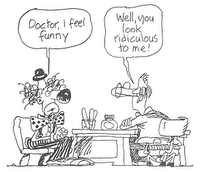
Doctor Doctor Joke: Patient: Doctor, I feel funny; Doctor: Well, you look ridiculous to me
(Source)
Medicare/Medicaid is the nearest thing that the US has to the NHS. People pay an amount each month out of their wages (I suppose, a bit like people in the UK pay National Insurance). Medicare is an insurance policy to provide medical care for those over 65 years old and some disabled people. Medicaid is a policy that provides treatment for those who are below the federally-defined poverty level.

As far as treatment is concerned, the UK media has countless nightmare stories about how people are treated on the NHS and I myself have had a few bad experiences. However, I can also say that I have seen a doctor on countless occasions (which here in the US would cost me a $15 excess for each visit) and have had a few operations/stays in hospital without having to part with a penny. If I moved house, I could just sign up at the nearest doctor's surgery.

In short, the NHS provides treatment to anyone regardless of socioeconomic status for free or near-free. Medical and dental provision (including prescribed medicines) for children is always free and most provisions for most adults is also free. Adults who earn above a certain wage have to pay for prescriptions (about £6 or so per prescription). As far as dental charges are concerned, we would visit the dentist twice a year and all I would pay for was £13 to have my teeth checked and polished. The option is available, for those who have the means, to pay for private medical provision, and private medicine does have its advantages. However, this is voluntary. One does not have to subscribe to private medicine just because one is well-off. One can still be treated by the NHS.
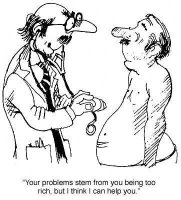
Doctor Joke: doctor says to patient: your problems stem from you being too rich, but I think I can help you
(Source)
When we first arrived in the US, we were handed a 3" thick lever-arch folder that explained the various insurance policy options that were available to us. We were (and to a large extent still are) flummoxed. The folder was mostly gobbledygook -- containing phrases like "...subject to the deductible, covered at 80% of coinsurance of plan allowance...". Translated into our level of understanding, this says "...@!*#$ !@ #$% *$&:^?@!$# etc..." After hours of reading through this tome we were very little wiser, so we just picked a plan and hoped for the best.

It's now a year later and we still don't have a doctor. Our medical insurance only pays out if we have a doctor from their approved list. Upon phoning around the local surgeries in our area that were on the list, we discovered that:

  1. the list is out of date and many of the surgeries on the list do not take patients with our insurance policy and
  2. those doctors that do not fall under (a) have a full quota of patients and are not taking any more on.
My next recourse is to try further afield, and see if we can get a doctor in the Durham area. It's true that for $150 or so extra a month, we can choose any doctor, not just one from a pre-approved list. However, as we've been here a year and haven't needed a doctor, $1,800 a year extra seem like rather a lot to pay.

As far as dentistry is concerned, we had our first visit to a US dentist recently. There were no treatments other than prophylaxis (fissure sealant for the kids' molars (charged per-tooth), polishing, x-rays), yet our bill exceeded our insurance payout by about $750. I dread to think what it would cost

  1. without insurance
  2. if we had to have any actual treatments
In the UK, all children's treatments are free and I've already mentioned the cost of an adult's check-up and polish. Last time I had an X-ray I didn't have to pay, but even if these days there is a small fee, it'd be nothing when compared to the cost here.

When one is living in the UK one can see the NHS's problems. No matter how much public money is ploughed into it, for various reasons it is always hungry for more. It's not until one leaves the UK that one begins to appreciate just how great an ideology and institution the NHS is and how much, despite its problems, it's worth fighting to keep.

Saturday, September 09, 2006

I Wish I'd Looked After Me Teeth

Oh, I wish I'd looked after me teeth,
And spotted the perils beneath,
All the toffees I chewed,
And the sweet sticky food,
Oh, I wish I'd looked after me teeth.
etc...
Pam Ayres

Steve Martin as the dentist in Little Shop of Horrors
A Trip to the Dentist
In the USA, almost everyone pays for almost everything and most people have a whole array of insurance policies to cover almost everything that one can think of. This includes medicine and dentistry. The UK has the NHS, which, despite its problems, makes me proud to be British. In the UK, we would pay about £13 each for a scale and polish for the adults and, as one would expect, it was always free for the children. The government payed the rest. The bill for our family trip to the dentist, for a similar amount of treament, in the USA was about $1500 plus an extra $500 or so of treatment that would most probably not have been prioritised by a UK dentist. Of this $2000, we had to part with $130 and the dental insurance policy covered the rest. The great thing about the NHS is that medical treatment is completely free and dental treatment is almost free for anyone regardless of socioeconomic status.

Austin Powers -- A Brit with bad teeth
A Brit with Bad Teeth
However, my recent State-side trip to the dentist has highlighted something that one can see in this and in other aspects of American life that is rarer in British life. This is the relationship between service providers and their recipients: that if one is paying for something up-front, one is likely to demand and therefore to receive a better quality of service. This is great for those who can afford it or have an employer who can afford it, but is less great for those who are less fortunate.

The USA seems to run on this principle. At the dentist, our initial "oral evaluation" was far more thorough than anything that I have ever experienced in the UK, with an emphisis on prophylactic treatment. In addition, the dentists/hygenists themselves are more polite and friendly. They realise that one can always take one's custom elsewhere, which is less easy to do in the UK.

While we're on the topic of teeth, what is the going rate for teeth at the moment?

When in England, our tooth fairy always used to give £1 per tooth. On the odd occasion, he'd forget to do his job, so we would have to negotiate compensation for his lateness to the tune of a 100% per tooth markup. Since moving to the US, the rate has been $1 per tooth, with the same penalty for lateness. However, we recently found out that Emily's friend's tooth fairy pays $5 per tooth. In addition, we were recentlyLarry David
Larry David
watching an episode of Curb Your Enthusiasm (one of the funniest programmes ever) wherein Susie's daughter, Sammi, has lost her last baby tooth and Susie is trying to put a $5 bill under her pillow (with disastrous consequences resulting from Larry using the upstairs loo very noisily whilst wearing very squeaky shoes). Is our tooth fairy particularly stingy? Should we be negotiating a better deal for our kids while they still have baby teeth to lose?